
Imports Without Tears
A practical, engineer-to-engineer guide to how Go pulls code into your project

“A language that doesn’t affect the way you think about programming is not worth knowing.” — Alan Perlis
I’ll be honest: I didn’t appreciate Go’s import system until it bit me. Not in a dramatic way; more like a silent compilation failure at 1 a.m. while I was over-caffeinated and under-rested. I’d moved a file, renamed a folder, and suddenly the entire build blew up like I had personally offended the Go compiler.
That’s when I realized something: imports in Go are simple, but they’re not stupid. They enforce structure, readability, and long-term maintainability. If your imports break, it’s usually because your project structure is lying.
This article is the “I wish someone told me this earlier” breakdown of how imports really work in Go, how the toolchain thinks, and how to avoid the subtle headaches that every Go engineer eventually trips over.
What an Import Actually Means in Go
When you write:
import “fmt”you’re not just pulling in a module. You’re telling the compiler:
Find this package by its import path.
Compile it if necessary.
Make its exported identifiers available to me.
The key is “exported identifiers.” Go doesn’t expose everything—only names starting with a capital letter:
fmt.Println   // exported
fmt.printMsg  // not exported, you can’t call it
Go is strict about this because it prefers clarity over cleverness.
Import Paths ≠ File Paths
A lot of new Go developers assume import paths are just folder names. Almost—but not quite.
For example:
example.com/myapp/utilsmight correspond to:
~/go/src/example.com/myapp/utilsOr, if using modules (Go 1.18+):
your-project-root/utilsBut here’s the deeper rule:
Import paths describe packages, not directories.
A directory is only a package if it’s structured like one.
Meaning:
It must contain Go files.
All files must share the same
packagename (except tests).A folder can only define one package.
The Three Import Styles You’ll See Everywhere
1. Standard import
import “net/http”Straightforward. Go handles it.
2. Renamed imports
Useful when packages collide or have long names.
import h “net/http”Better:
import httpserver “github.com/user/project/server/http”Your future self will thank you.
3. Blank imports
Probably the most misunderstood Go feature:
import _ “github.com/mattn/go-sqlite3”People think it’s useless. It’s the opposite.
The blank identifier tells Go:
“Import this package only for its side effects.”
Specifically, its init() functions.
Database drivers are the canonical case.
Single vs Multi Import Blocks
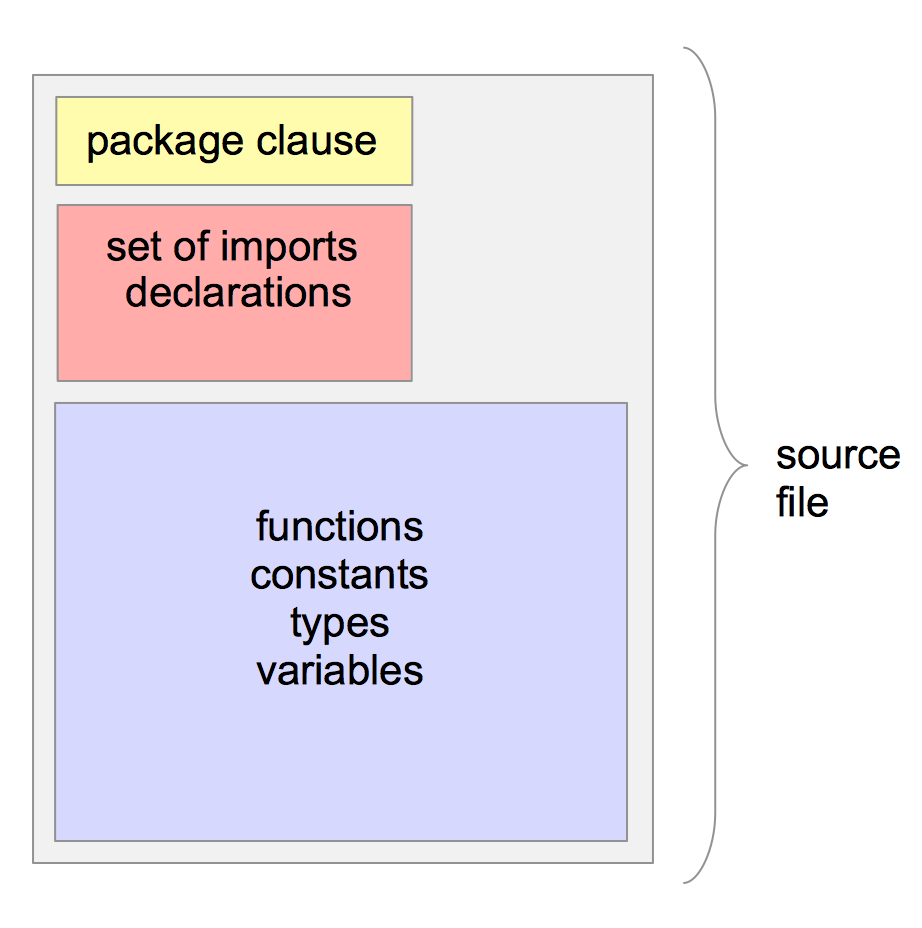
All of these are valid:
import “fmt”
import “os”
or:
import (
    “fmt”
    “os”
)
Most Go developers (and go fmt) prefer the grouped style.
Grouped imports can also be sectioned:
import (
    “fmt”

    “github.com/pkg/errors”

    “myapp/internal/metrics”
)
Standard → third-party → internal.
This makes diffs far cleaner.
How go mod Changed Everything
Before modules, GOPATH ruled everything. Packages lived under:
~/go/src/and you had to shape your import paths around that.
Now:
You can import relative to your module.
You can version external dependencies.
Reproducible builds became normal instead of mythical.
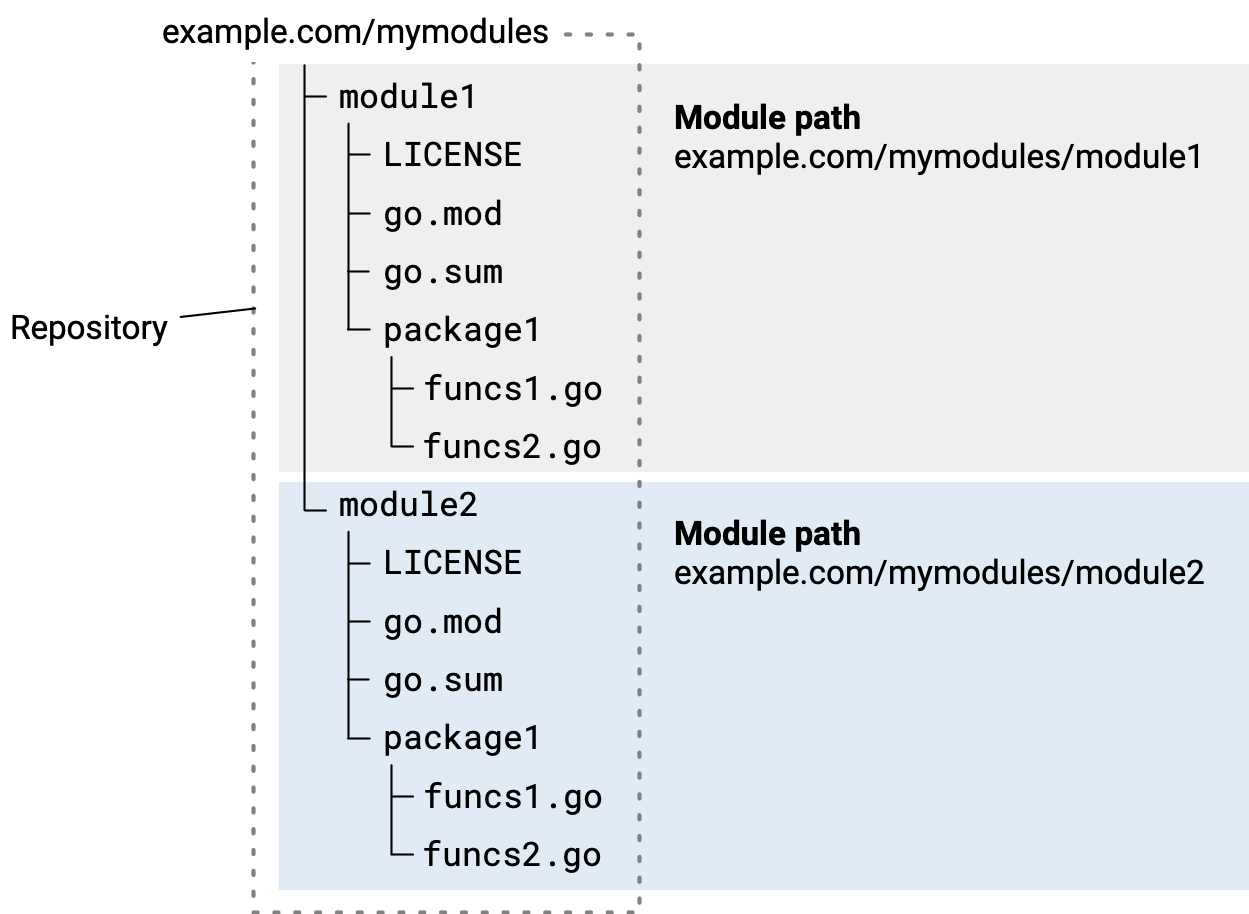
Example go.mod:
module github.com/you/project

go 1.23

require (
    github.com/gorilla/mux v1.8.1
)![Learn Intermediate Go] Go Modules | by Sang-gon Lee | Nerd For Tech | Medium](https://substackcdn.com/image/fetch/$s_!Z0yA!,f_auto,q_auto:good,fl_progressive:steep/https%3A%2F%2Fsubstack-post-media.s3.amazonaws.com%2Fpublic%2Fimages%2F0a1dc9af-f05a-43c5-b1cf-89c93da688f2_960x540.png "Learn Intermediate Go] Go Modules | by Sang-gon Lee | Nerd For Tech | Medium")
Imports inside your code simply reference paths from the module root:
import “github.com/you/project/internal/auth”
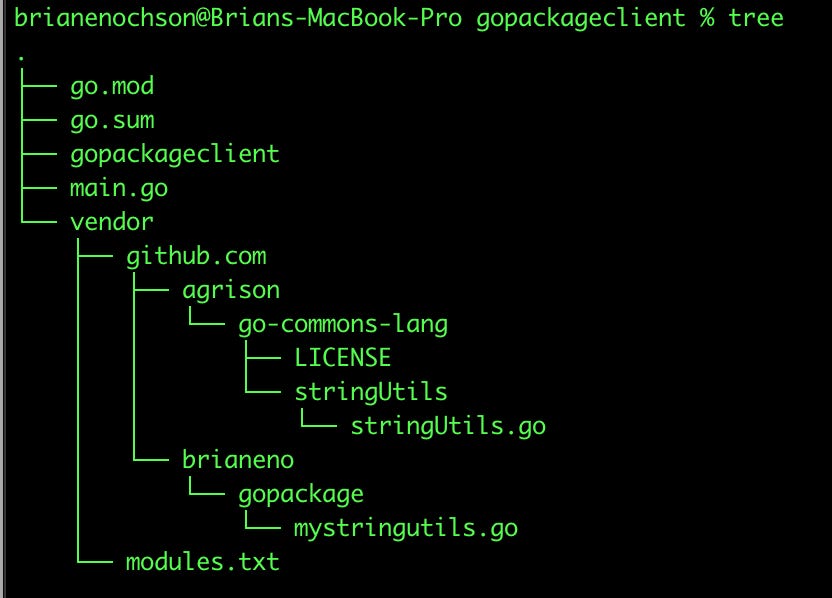
go.moddefines a Go module, specifying its name, required Go version, and direct dependencies with their versions, whilego.sumprovides cryptographic checksums for all direct and transitive dependencies to ensure supply chain security and reproducible builds.
go.mod
The
go.modfile defines a Go module and its direct dependencies.It acts as the root of dependency management for a Go project.
It explicitly lists the required modules and their versions that your project directly uses.
It can also include directives like
replace(to substitute a module path) andexclude(to prevent specific module versions).This file is primarily for human readability and for the Go toolchain to understand the project’s dependency graph.
go.sum
The
go.sumfile stores cryptographic checksums (hashes) of all modules required by a Go project, including both direct and indirect dependencies.It is automatically generated and updated by the Go toolchain when commands like
go build,go test, orgo mod tidyare executed.The primary purpose of
go.sumis to ensure the integrity and authenticity of downloaded modules.By verifying the checksums against the
go.sumfile, the Go toolchain can detect if any dependency has been tampered with or corrupted, thus preventing supply chain attacks.It ensures that builds are reproducible, meaning that the same code will always produce the same binary, regardless of when or where it’s built, as long as the
go.sumfile is consistent.
In essence.
go.moddeclares what dependencies your project needs and their versions.go.sumguarantees the integrity of those dependencies by storing their checksums, ensuring that the exact versions specified ingo.modare used and haven’t been altered.
Circular Imports. The One Mistake Go Refuses to Ignore
If package A imports B, and B imports A, Go will not build your project.
It’s one of the few compiler errors that feels more like a life lesson than a technical constraint.
Circular imports usually mean:
You’re mixing responsibilities.
Your packages aren’t decoupled.
You need an internal interface split.
A quick fix is often creating a third package that holds shared abstractions.
pkg/
   models/
   handlers/
   shared/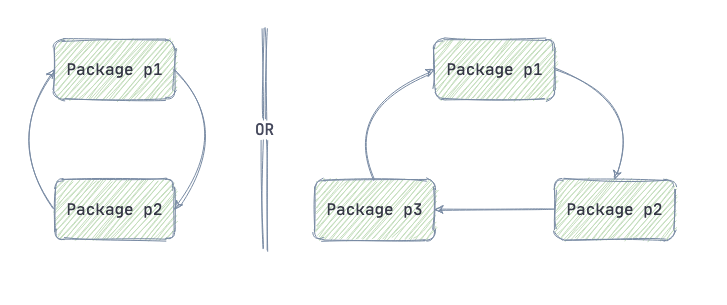
In Go, an import cycle (also known as a cyclic dependency) occurs when two or more packages directly or indirectly depend on each other. This creates a closed loop in the project’s dependency graph, which the Go compiler explicitly disallows.
How import cycles occur.
Direct Cycle. Package
Aimports packageB, and packageBimports packageA.Indirect Cycle. Package
Aimports packageB, packageBimports packageC, and packageCthen imports packageA.
Why Go disallows import cycles.
Compilation Speed. Circular dependencies would make compilation significantly slower, as the compiler would need to recompile dependent packages whenever a change occurs within the cycle.
Code Organization and Design. Disallowing import cycles forces developers to design their code with clear, unidirectional dependencies, promoting better structure and maintainability. It prevents the creation of tightly coupled “blobs” of code that are difficult to understand, test, and refactor.
Reduced Complexity. A clean dependency graph, free of cycles, makes it easier to reason about the flow of data and control within a project.
How to resolve import cycles.
Resolving import cycles typically involves restructuring your code to break the circular dependency.
Introducing an Interface. If a package needs to interact with another package’s types or methods but doesn’t need direct access to its concrete implementation, define an interface in a third, independent package. The first package can then depend on this interface, and the second package can implement it.
Dependency Injection. Instead of direct imports, pass dependencies as arguments to functions or methods, allowing a higher-level “main” or “entrypoint” package to manage the connections between different components.
Refactoring Package Structure. Reorganize your packages to ensure a clear, hierarchical dependency flow, where dependencies always point “downwards” in the conceptual structure.
Imports + Init() = Hidden Complexity
Each imported package can have multiple init() functions.
Order matters:
Dependency packages run their
init()first.Your package’s
init()runs last.
This can lead to unexpected behavior if:
You rely on global initialization.
You import packages only for side effects.
You unintentionally introduce an init loop.
Rule of thumb:
Avoid init() unless you truly need it.
How Go Treats Unused Imports
Go is ruthlessly strict:
imported and not used: “fmt”This is intentional.
Unused imports are a code smell:
You removed code but not dependencies.
Something stale is lingering.
The package should not be there anymore.
It keeps your codebase clean—even when you get lazy.
Common Pitfalls (And Quick Fixes)
1. “Cannot find package” error
Your folder structure doesn’t match the import path.
2. “Ambiguous import”
Two packages with the same final directory name. Rename one:
import metricsv2 “github.com/you/project/metrics/v2”3. Import cycles
Split your dependencies.
Favor interfaces over concrete types.
Final Thoughts
Go’s import system is one of those quiet features that shapes the way Go applications scale. It pushes you—sometimes gently, sometimes aggressively—toward clean boundaries, explicit dependencies, and predictable builds.
The longer you write Go, the more you realize the import system isn’t restrictive; it’s protective. It guards your architecture, your namespace, and your sanity.
If you’ve ever had your build break because of a meaningless-looking import line…
same here. That’s why I wrote this.
Really loved the part about circular imports being a life lesson more than a techincal constraint. Most languages let these slide, but Go forces the refactor and that ends up exposing where responsibilities are blurred. The distinction between go.mod (what you need) and go.sum (integrity proof) is underrated too, especally for supply chain security.